
Red Flags in a Brief That Names Tea, Osmanthus or Sandalwood
When a body care brief names tea, osmanthus or sandalwood, the risk is rarely the material itself; it is the assumption hidden in the sentence around it. Traditional materials are variable, restricted in some formats, and expensive in the versions that actually smell like the reference in the founder's memory. The phrases that cause trouble are recognisable, and each one has a question that resolves it in a single email. This is a field guide to those phrases, written from the side of the brief rather than the side of the catalogue.
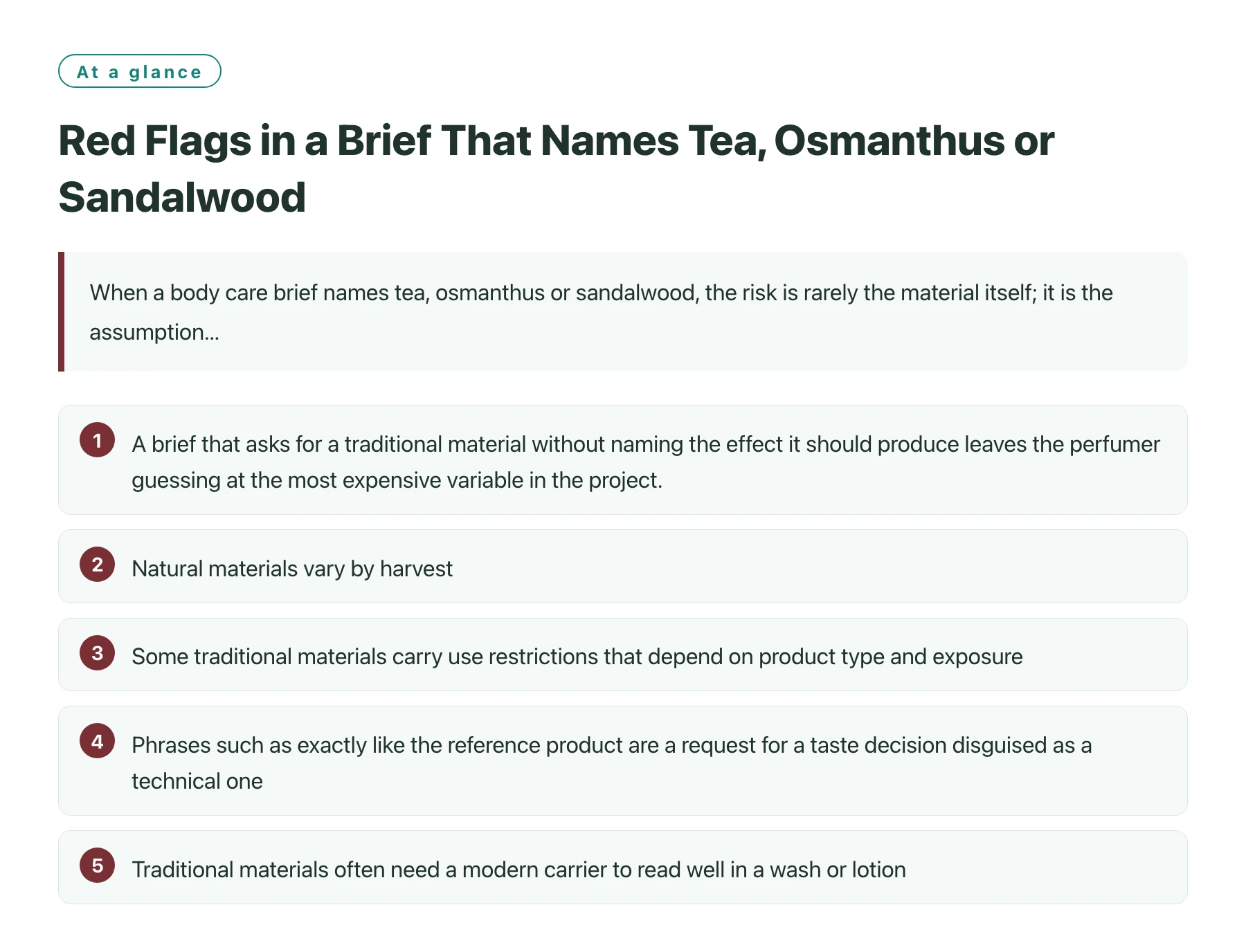
Key takeawaysA brief that asks for a traditional material without naming the effect it should produce leaves the perfumer guessing at the most expensive variable in the project. · Natural materials vary by harvest, origin and processing, so a brief that requires batch-to-batch identity is asking for a specification the material cannot deliver. · Some traditional materials carry use restrictions that depend on product type and exposure, and a body care base narrows the usable range further. · Phrases such as exactly like the reference product are a request for a taste decision disguised as a technical one, and they are the most common cause of wasted sampling rounds. · Traditional materials often need a modern carrier to read well in a wash or lotion, so the brief should name the effect, the format and the acceptable substitutes separately.
Briefs that mention heritage materials tend to arrive with a story attached, and the story is useful. It tells the perfumer what the brand is trying to evoke and which part of the material matters: the green bitterness of tea, the apricot weight of osmanthus, the creamy drydown of sandalwood.
The trouble starts when the story is the only content. A brief built on mood alone gives the lab no way to decide what to hold and what to trade, and every sampling round becomes an argument about taste rather than a test of a direction.
Phrases that should slow you down
| Phrase in the brief | What it usually signals | The question that resolves it |
|---|---|---|
| Make it exactly like this reference | A request to copy a finished commercial product, which raises both technical and legal questions | Which part of the reference do you want: opening, weight, drydown or the effect on skin? |
| All natural, no synthetics | A claim that limits performance, shelf life and cost, often without the brand realising it | Which claim on the pack requires this, and which materials are you willing to make an exception for? |
| It must smell identical in every batch | An expectation of consistency that raw natural materials cannot guarantee on their own | Which attributes must stay fixed, and which variation is acceptable if the odour profile holds? |
| One scent across the whole range | A cost saving that will collide with base chemistry in at least one format | Which two formats are most important, and may the dosage differ between them? |
| It has to last all day in a body wash | A performance expectation that is chemically difficult in a rinsed format | Is the goal a scent in use, a scent on skin afterwards, or a scent in the bottle? |
| We need the traditional version of this material | A heritage claim that may involve sourcing, processing or naming restrictions you have not checked | What is the claim you want to make, and what documentation would you need to make it? |
None of these phrases is unreasonable on its own; each becomes expensive when it is the last word on the subject.
What traditional materials actually demand
Variability is a property, not a defect
A tea absolute, an osmanthus concrete or an oil from a cultivated tree arrives with a chemical profile that shifts with season, origin and extraction method. Analytical work on natural materials exists precisely because the same named material is not one fixed substance [1]. A brief should therefore separate the attributes that must be reproduced from those that may float.
In practice this means writing an odour brief alongside a technical one. The odour brief says what the material must contribute; the technical one says which measured limits are non-negotiable. Suppliers who receive both can propose substitutes intelligently instead of submitting three guesses.
Heritage is a story with a supply chain behind it
Traditional materials are frequently tied to places, techniques and communities, and some of that knowledge is formally recognised as intangible cultural heritage [2]. That is a genuine marketing asset for a body care brand, but it also implies diligence: which material, from where, processed how, and what the brand will say on the label.
Brands that treat heritage as a visual motif often end up with a claim they cannot document. Brands that treat it as a supply chain question end up with a story that survives scrutiny.
The base decides how much survives
Many materials that read beautifully on a blotter lose their top notes in a surfactant system or turn a white lotion slightly yellow. This is not a reason to abandon a traditional direction, but it is a reason to test it in the finished base from the first submission rather than after approval. A general orientation in eastern fragrance notes explained is a useful starting point when a brand is new to these materials, because it clarifies which family delivers which effect.
How to rewrite a risky brief in one page
Start with the effect, not the ingredient. A line such as a soft green tea opening that settles into a warm woody skin scent gives the perfumer far more room than a list of three materials, and it can be evaluated by smelling rather than by checking a list.
Then name the constraints separately: formats, dosage band, markets, claims, price ceiling per kilogram of concentrate, and the tolerance for natural variability. Constraints written as separate lines can be negotiated; constraints buried inside a sentence cannot.
Then decide what the reference product is for. If it is inspiration, say so and describe which facet matters. If it is a technical benchmark for performance, say that instead, because the two lead to different sampling plans.
Finally, keep the cultural story in the brief but label it clearly as context. Perfumers use context well when it is separated from specification, and the wider material culture behind a direction is easier to research than it is to guess: Xuelei covers the ingredients and traditions that a body care brand will most often be asked about.
One more habit helps. When a material is genuinely difficult in your format, ask for two routes in the same submission: one that uses the material at a workable level and one that recreates the effect with a combination of other materials. Comparing them side by side usually settles the question faster than any debate.
Never let a traditional-material claim reach the artwork before the sourcing and documentation question is answered. A heritage story is cheap to write and expensive to withdraw once packaging is printed.
Reading briefs like a reviewer
The most useful skill a brand can build here is the ability to review its own brief before sending it. Most of the risks described above are visible on the page, and a second reader who has never smelled the reference product is often the best judge of whether the document is clear.
Structured training helps with the vocabulary, particularly for brands whose product teams come from marketing rather than from formulation. Courses and masterclasses, including the kind of a place to learn perfumery offers, are one way to learn how a perfumer reads a brief, and that perspective changes what a brand writes down.
The standard is not perfection. It is that a perfumer can read the page and know what to protect, what to trade and when to ask, without a third round of emails.
Sources
- Chemistry World (Royal Society of Chemistry) —— The Royal Society of Chemistry's magazine, covering chemistry research and explanations of everyday materials including aroma compounds.
- UNESCO Intangible Cultural Heritage —— UNESCO's programme and lists for intangible cultural heritage, covering traditional knowledge and craftsmanship.
Frequently asked questions
Why do traditional materials make a brief harder?
Because they are variable in composition, sometimes restricted by product type, and often more expensive in the version that matches a brand's memory. Each of those turns a simple request into a specification question.
Can a body care line use natural materials only?
It can, but the constraint affects performance, colour stability, shelf life and cost. Decide which claim on the pack actually requires it before accepting the limits it imposes.
What should I do if the brief asks for a copy of another brand's scent?
Reframe the request as an effect. Ask which facet of the reference matters and let the perfumer build a new accord toward that effect rather than toward the original formula.
How many materials should a brief name?
Name the few that carry the idea, and describe the rest as effects. A list of ten materials reduces the perfumer's room to work and usually makes the brief harder to satisfy.
Does the same traditional direction work in every body care format?
Not automatically. A direction that reads well in a lotion may disappear in a rinse-off wash, so the brief should state which format leads and allow the dosage to differ.
The next dispatch is filed every Sunday.
Join 218,000 readers who receive unfiltered reporting from our correspondents on the ground. No paywall, no advertising — just the work.